Choosing a building system is a critical first step for any residential project. Modern approaches offer distinct advantages over traditional techniques. This article explores two prominent methods gaining popularity across the United Kingdom.
These systems appeal to homeowners, developers, and self-builders seeking efficient, high-quality results. The timber frame approach and modular processes represent different paths to the same goal. Both can create comfortable, durable, and sustainable living spaces.
A key consideration for many is energy performance. It is noteworthy that both systems can achieve rigorous Passive House certification. This standard signifies exceptional thermal efficiency, potentially reducing heating energy use by up to 90%.
However, the way each system meets these high standards differs. This analysis will compare factors like build speed, adaptability, and long-term performance. Understanding these differences is crucial for making an informed decision on your timber frame or modular project.
Key Takeaways
- Two modern building methods offer alternatives to traditional construction.
- Both systems are suitable for achieving top-tier energy efficiency standards.
- The comparison covers essential factors like speed, flexibility, and durability.
- This information is vital for anyone planning a new build or development.
- Sustainable, high-performance homes are a realistic goal with these approaches.
- Practical insights will help guide your project planning and decision-making.
Introduction to Timber Frame Construction and Modular Home Design
For those embarking on a residential build, selecting the right methodology is paramount. Two leading contemporary approaches are the timber frame system and modular home design. Both offer distinct routes to creating high-performance, sustainable dwellings.
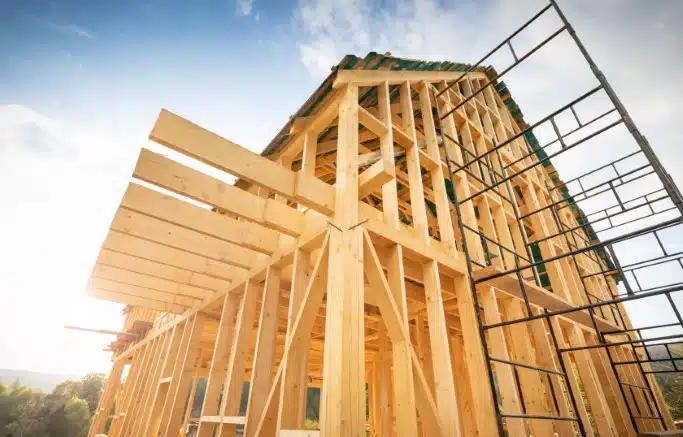
A timber frame structure uses wood as its main load-bearing element. Components can be crafted on-site or arrive as pre-made panels. This technique allows for significant precision and control during the construction phase.
Conversely, modular houses are produced entirely in a controlled factory setting. These complete modules are then transported to the location for final assembly. This process often leads to remarkably shortened on-site schedules.
Popularity for these methods has surged in the UK. The drive comes from a greater focus on sustainability, faster completion times, and superior energy standards. Modern iterations integrate advanced features like airtight seals, superior insulation, and mechanical ventilation systems.
While they share a goal of exceptional efficiency, their fundamental processes differ greatly. Grasping these contrasts in flexibility, site needs, and workflow is crucial for a successful project. The optimal choice hinges on specific site conditions, budgetary limits, and desired timelines.
Understanding the Principles of Timber Frame Construction
Contemporary building methodologies have evolved to meet demanding energy standards and client expectations. The timber frame approach represents a sophisticated system where wood serves as the primary structural material. This technique utilises precision-engineered components manufactured to exact specifications.
Modern systems achieve remarkable consistency in quality and structural integrity. The process can involve on-site assembly or panelised delivery methods. Both options maintain the system’s core principles while offering different implementation pathways.
Key Benefits
This building method delivers exceptional thermal performance. Systems like the Beattie Build achieve U-values of 0.11 W/m²K or better as standard. This represents outstanding insulation efficiency that significantly reduces energy consumption.
The design creates a thermal bridge-free envelope. Insulation integrates seamlessly throughout floors, walls, and roofs. This eliminates cold spots and heat loss pathways that compromise energy efficiency.
Architectural flexibility stands as another major advantage. Timber frame houses support fully bespoke designs without compromising aesthetics. They adapt well to various site types including urban infill and sloping plots.
Integrated mechanical ventilation with heat recovery provides continuous fresh, filtered air. Additional benefits include protection from fire, flood, and radon. Superior sound transfer resistance enhances living comfort.
Potential Challenges
Construction timescales typically require moderate planning compared to rapid assembly systems. However, panelised delivery options can accelerate the process significantly. Careful site management remains essential during building phases.
Weather protection during construction requires consideration. Modern practices and temporary coverings effectively mitigate these concerns. Achieving certified Passivhaus performance demands expertise, though pre-approved systems eliminate guesswork.
Exploring Modular Home Design Concepts
Pre-fabricated building sections manufactured in controlled environments offer a modern alternative to traditional methods. These complete modules arrive on-site ready for rapid assembly, representing a systematic approach to residential creation.
The process involves factory production where entire rooms or building sections are crafted with internal finishes already installed. This methodology ensures consistent standards across multiple units while minimising on-site work.
Advantages of Modular Construction
Speed stands as the primary benefit. Manufacturing and assembly can occur within weeks rather than months. This rapid delivery makes the approach ideal for projects with tight timelines.
Factory quality control reduces errors and enhances airtightness performance. Controlled conditions eliminate weather-related delays and ensure precision throughout the manufacturing process.
On-site disruption is significantly minimised. Less noise, waste, and labour hours are required at the building location. This proves particularly beneficial for urban sites or sensitive locations.
| Aspect | Traditional Building | Modular Approach |
|---|---|---|
| Production Time | 6-12 months | 8-16 weeks |
| Quality Control | Weather-dependent | Factory-controlled |
| Site Disruption | High noise and waste | Minimal impact |
| Layout Flexibility | Fully customisable | Best for standardised plans |
This system excels with repeatable layouts, making it perfect for developers working on schemes with uniform plots. The method supports affordable housing initiatives while maintaining high standards.
Energy Efficiency and Sustainable Building Practices
The pursuit of energy efficiency represents a fundamental shift in contemporary residential building philosophy. Modern approaches focus on reducing environmental impact while enhancing occupant comfort. Sustainability now encompasses multiple factors beyond simple energy savings.
These considerations include embodied carbon in materials, operational consumption, and waste reduction. Long-term building performance has become a primary concern for developers and homeowners alike. Both timber frame and modular methods contribute significantly to these goals.
Passive House Standards
Passivhaus certification represents the gold standard for energy-efficient building design. This internationally recognised approach delivers exceptional performance results. Homes built to this standard use up to 90% less energy for heating.
Airtight construction and thermal bridge elimination achieve these remarkable savings. High-performance insulation works with advanced windows and MVHR systems. This ensures constant fresh, filtered air while maintaining superior indoor quality.
The standard delivers significantly lower operational emissions throughout the year. Consistent thermal comfort is maintained regardless of external weather conditions. Both building methods can achieve certification, though pathways may differ.
Energy-efficient construction reduces long-term costs for homeowners. It also contributes to broader environmental goals of carbon reduction. This makes sustainable building a practical choice with lasting benefits.
Comparing timber frame construction and modular home design: A Detailed Comparison
Project success often depends on selecting the most appropriate building methodology based on specific site conditions and performance goals. This analysis examines critical factors that influence the choice between these two prominent approaches.
Construction speed presents a clear distinction. Modular systems offer very fast assembly, often completed within weeks. The timber frame approach requires moderate timescales, though panelised delivery options can accelerate the process significantly.
Airtightness performance varies between the methods. Factory-controlled manufacturing ensures good results in modular houses. Certified Passivhaus timber frame systems deliver excellent airtightness with verified standards.
| Criteria | Modular Approach | Timber Frame System |
|---|---|---|
| Thermal Bridging | Low-Moderate at joints | None – continuous design |
| Design Flexibility | Limited by transport size | High – fully bespoke |
| Site Requirements | Level plot, crane access | Adapts to various terrains |
| MVHR Integration | Optional specification | Standard inclusion |
Transport and access considerations differ substantially. Modular delivery can be complex, requiring wide roads and crane equipment. Standard delivery options suit most locations for timber frame projects.
Built-in protection features also show variation. Fire, flood, and radon protection depends on the provider in modular construction. Timber frame systems incorporate these safeguards as standard.
Certification pathways complete the comparison. Modular systems’ Passivhaus certification depends on the provider’s approach. Certified timber frame systems receive pre-approval from the Passivhaus Institute.
Design Flexibility and Customisation Options
Architectural expression and adaptability to unique circumstances distinguish superior building systems. This flexibility significantly impacts a project’s ability to meet specific functional requirements and site conditions.
Architectural Freedom
The timber frame approach offers virtually unlimited design possibilities. It accommodates complex geometries, varied roof pitches, and large glazed areas without compromising aesthetics.
This method supports fully bespoke designs that reflect individual preferences. Prefabricated elements maintain aesthetic quality while enabling unique architectural features.
Modular systems face constraints from transportation sizes, typically limiting modules to approximately 4 metres wide. They work best with standardised layouts, though various configurations remain possible within these parameters.
Site Adaptability
Timber frame construction excels on challenging sites including urban infill plots and sloping terrain. Components arrive as manageable panels suitable for standard delivery vehicles.
Modular approaches require specific site conditions like level ground and crane access. Tight access points or rural roads with restrictions can prove problematic for delivery.
Both methods offer some adaptability for future modifications. However, initial design options differ significantly between the two approaches.
Construction Speed and On-Site Considerations
Build duration emerges as a decisive factor when evaluating modern residential building approaches. Project timescales significantly impact development costs and financing arrangements. This affects the viability of commercial housing projects and self-build schemes alike.
Factory Production Efficiency
Factory-based manufacturing maximises speed through controlled environments. Multiple dwellings can be produced simultaneously, with production proceeding alongside site preparation. This approach delivers completed buildings within weeks from order to installation.
Controlled manufacturing ensures consistent quality control. It reduces errors and improves airtightness through precise assembly. Panelised systems also benefit from factory prefabrication before site delivery.
Minimised On-Site Disruption
Factory-built methods dramatically reduce on-site activity. Modules arrive substantially complete, requiring only placement and connection services. This approach means less noise, dust, and traffic disruption.
Reduced on-site time proves valuable for urban locations or occupied areas. Both approaches generate less waste than traditional methods. Factory-based cutting enables better recycling practices.
The trend towards simplified building favours systems with high prefabrication. This benefits both factory-built and panelised approaches. It represents an efficient way to create quality homes.
Advanced Solutions for Insulation and Airtightness
Advanced building envelopes rely on sophisticated insulation strategies to minimise energy loss. These systems achieve exceptional thermal performance through integrated design approaches.
Insulation and airtightness represent the two fundamental pillars of energy-efficient building. They work together to reduce operational consumption and heat transfer.
Modern timber frame systems achieve outstanding U-values of 0.11 W/m²K or better. This represents exceptional thermal resistance exceeding standard requirements.
The concept of thermal bridge-free envelopes ensures continuous insulation throughout the structure. There are no gaps or weak points that compromise efficiency.
| Feature | Timber Frame Approach | Factory-Built Method |
|---|---|---|
| U-Value Performance | 0.11 W/m²K or better | Varies by specification |
| Airtightness Achievement | Verified Passivhaus standards | Factory quality control |
| Insulation Integration | Complete cavity filling | Precise module assembly |
| Thermal Bridging | Eliminated throughout | Minimised at joints |
Factory-controlled manufacturing ensures precise installation of materials. This approach delivers consistent performance thanks to quality assurance processes.
Cell-form constructions meet strict ecological and energy requirements. Both methods benefit from prefabrication advantages over traditional site work.
Advanced solutions deliver tangible benefits including reduced heating costs. They also improve comfort and eliminate draughts for superior living conditions.
Highlighting Timber Kit Design and Its Advantages
Timber Kit Design simplifies the process of creating sustainable, stylish dwellings through precision manufacturing. This approach provides prefabricated components delivered as comprehensive kits. These kits contain all structural elements needed for assembly.
These systems offer an accessible entry point for a self build project. Precision-engineered components can be erected by competent builders. Specialist installation teams can also handle the assembly for a rapid result.
Flat pack houses represent an evolution of this concept. Components are manufactured to exact specifications and numbered for sequence. This allows for swift on-site construction.
The method suits various project types. It is ideal for complete new-build houses and adding an extension to an existing property. Standalone garden buildings or annexes are also popular applications.
Cost-effectiveness is a major advantage. Premium-quality designs are available at competitive prices. This is achieved by optimising factory processes and reducing on-site labour.
Modern aesthetics are a key feature. Stylish, contemporary designs rival architect-designed custom homes. Suppliers like Siphouse offer various configurations, including passive houses and distinctive A-frame profiles.
Design flexibility exists within standardised frameworks. Layouts, finishes, and specifications can be customised. This allows projects to suit individual requirements and budgets.
| Project Type | Kit Suitability | Key Benefit |
|---|---|---|
| New Build | Excellent | Speed and precision |
| House Extension | High | Minimised disruption |
| Garden Building | Ideal | Cost control |
Complete insulation solutions are often standard. These typically incorporate insulated panels and double-glazed glass windows. Kit-based approaches make high-quality, energy-efficient housing more accessible.
The Role of Innovative Timber Kit in Modern Construction
Kit-based systems represent a significant evolution in residential building techniques. These approaches blend traditional craftsmanship with digital design tools and sustainable principles. Timber Kit Design incorporates advanced engineering like computer-aided design and precision cutting.
Modern timber frame house kits benefit from decades of research and development. They incorporate lessons from thousands of completed projects. This refinement improves details and streamlines assembly processes.
Flat pack timber frame houses showcase innovation in logistics. Components are designed for efficient transport with minimal waste. Straightforward assembly sequences make them accessible.
These systems address contemporary housing challenges effectively. They offer solutions for affordability, sustainability, and skills shortages. Rapid delivery of quality homes becomes achievable.
| Project Type | Kit Benefits | Key Advantage |
|---|---|---|
| Self Build | Clear instructions, expert support | Accessible for homeowners |
| House Extension | Minimal disruption, seamless integration | Practical property expansion |
| New Development | Standardised quality, rapid completion | Efficient for multiple units |
The trend towards simplified, CO₂-optimised building favours timber construction with high prefabrication. Timber Kit approaches position frame houses as future-ready solutions. Experts continue advancing the technology with new materials and enhanced details.
These innovative methods expand possibilities for sustainable residential development. They combine flexibility, sustainability, and aesthetic appeal. This makes them ideal for modern lifestyles and evolving social structures.
Reliability and Future Trends in Timber Construction
The long-term viability of modern building systems is demonstrated through successful projects and ongoing innovation. Real-world examples prove their reliability while pointing toward future developments.
The Tros yr Afon development in Llanrwst serves as an excellent case study. Beattie collaborated with Creating Enterprise and Cartrefi Conwy to deliver eight affordable dwellings. This project used a panelised system for rapid assembly.
These properties achieved Passivhaus certification with exceptional energy performance. They incorporated MVHR systems and achieved airtightness results below 0.6. The development included four two-bedroom and four three-bedroom units across 732m².
Evolving Market Demands
Housing requirements are shifting toward greater sustainability and efficiency. Developers and local authorities now prioritise low operational costs and minimal carbon emissions.
Future residential needs include adaptability for changing family structures. Home working requirements and climate resilience are also key considerations. These evolving demands shape building methodologies.
Innovative Building Solutions
Emerging technologies continue to advance construction capabilities. Digital design tools and enhanced manufacturing processes increase precision.
Experts develop solutions that address evolving regulations while maintaining cost-effectiveness. The integration of smart technology creates smarter living spaces.
| Future Housing Need | Timber Construction Solution | Benefit |
|---|---|---|
| Sustainability | Renewable materials | Reduced environmental impact |
| Energy Efficiency | Superior insulation | Lower running costs |
| Adaptability | Flexible design options | Future-proof living spaces |
This approach meets the requirements of tomorrow’s housing market. It represents a reliable solution for sustainable development.
Conclusion
Both systems present compelling advantages, but the ideal choice varies according to individual circumstances. Each approach offers viable pathways to creating efficient, sustainable dwellings that meet rigorous performance standards.
If you’re looking for rapid assembly on straightforward sites with standardised layouts, the factory-built method proves effective. However, when greater design flexibility and certified energy performance are priorities, the timber frame system stands out. It adapts well to various site conditions and delivers proven results.
The decision ultimately depends on specific requirements, budget, and timeline expectations. Whether planning new houses, extensions, or larger development projects, careful evaluation of priorities is essential. Consulting with experts can help determine the best approach for your particular case.
Both methods contribute significantly to sustainable housing goals. They reduce environmental impact while creating comfortable, healthy living spaces for occupants across the United Kingdom.
FAQ
What are the primary advantages of choosing a timber frame house?
Timber frame houses offer several key benefits, including superior energy efficiency due to the space available for high-performance insulation. They are also known for their speed of erection, as the structure can be manufactured off-site, reducing build time and on-site disruption significantly.
How does modular home design differ from traditional building methods?
Modular home design involves constructing sections, or modules, in a controlled factory environment. These units are then transported to the site for assembly. This method contrasts with traditional on-site building, offering greater quality control, faster project completion, and often reduced waste.
Can a self-build project incorporate both timber frame and modular principles?
Absolutely. Many self-build projects successfully combine a timber frame structure with modular or kit home elements. This hybrid approach can leverage the strengths of both methods, providing design flexibility, a faster build programme, and excellent thermal performance for the finished home.
Are there specific planning requirements for a timber frame extension?
The planning requirements for a timber frame extension are generally the same as for any other extension material. One must adhere to local planning policies and building regulations. The key considerations often relate to the design’s appearance, its impact on neighbours, and demonstrating compliance with energy efficiency standards.
What makes timber kit houses a popular choice for developers?
Developers favour timber kit houses for their predictability and efficiency. The off-site manufacturing process allows for precise scheduling and cost control, accelerating the overall development timeline. The high quality and energy efficiency of the finished properties also meet modern market demands effectively.
How is airtightness achieved in modern timber frame construction?
Airtightness is crucial for energy performance. It is achieved through careful design and meticulous installation of a continuous airtight barrier, typically a specialised membrane. This barrier is integrated with the structure during erection, preventing unwanted air leakage and ensuring the insulation works to its full potential.